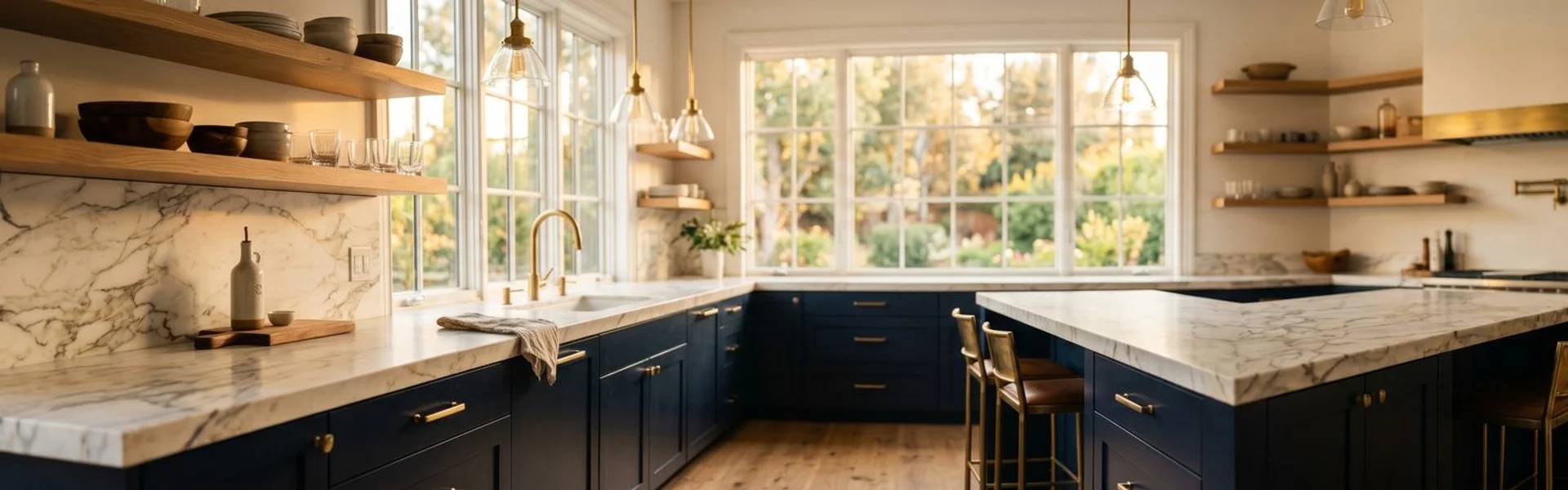
Most condo kitchens in Vaughan give you 60 to 150 square feet to work with. As average new unit sizes shrink, that tight footprint is still plenty of space for a small condo kitchen to perform brilliantly. Here are the four layouts we design most often.
The four condo layouts
Almost every successful VMC condo kitchen uses one of four floor plans: the galley, L-shape, single-wall, or open-plan. A typical cabinet installation costs $500 to $650 per linear foot, so choosing the right shape directly controls your budget.
| Layout Type | Best For | Typical Footprint |
|---|---|---|
| Galley | Narrow tower units | 60 to 100 sq ft |
| L-shape with peninsula | Families and larger units | 100 to 150 sq ft |
| Single-wall | Studios and bachelors | 35 to 70 sq ft |
| Open-plan integration | Older closed rooms | Varies widely |
Galley: the most common condo layout
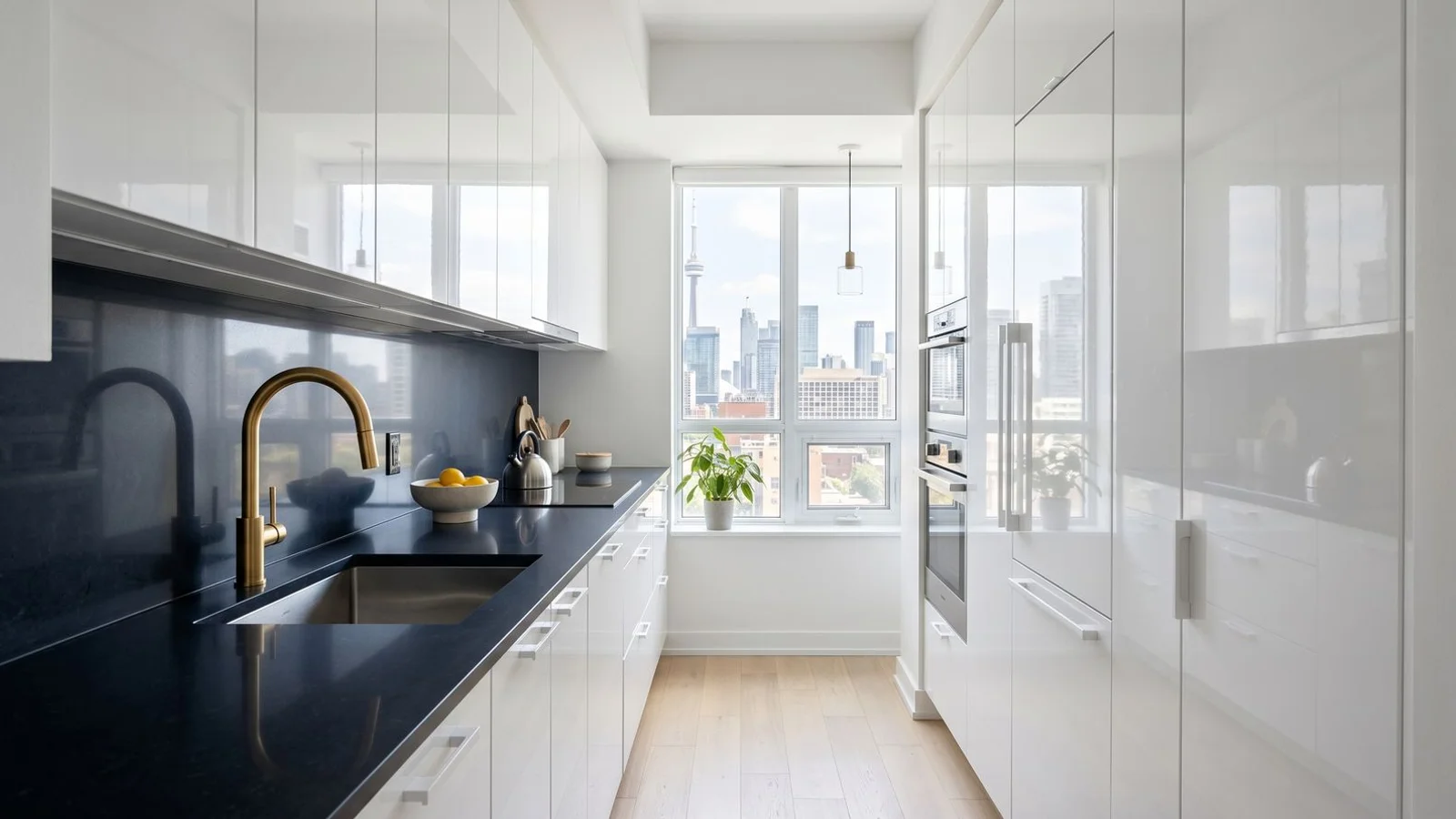
A galley kitchen has two parallel counter runs facing each other, separated by a central walkway. NKBA guidelines require 42 to 48 inches of walking space between opposite counters so two people can open opposing appliance doors.
Best for: narrow tower units, single-cook households, and layouts where one wall is exterior glazing.
Strengths:
- Maximum counter and storage in a minimum footprint.
- Efficient cooking zones with a tight work triangle.
- Two cooks can work simultaneously if separated by task.
Trade-offs:
- Two cooks crossing paths can feel cramped.
- Less casual seating, since there is no island.
- Upper cabinet planning needs extra care when one wall has windows.
A counter-depth integrated fridge that sits flush with the cabinetry solves the cramped-aisle problem.
L-shape with peninsula: the family condo default
An L-shape uses two perpendicular counter runs with an extended peninsula for casual seating. A seating overhang needs 12 to 15 inches of countertop depth to be comfortable.
Best for: one-bedroom-plus-den and two-bedroom condos, and owners who want bar seating.
Strengths:
- Distinct prep zone and clean-up zone.
- Casual seating without a separate dining area.
- An open feel, since the peninsula does not fully wall off the kitchen.
Trade-offs:
- The open side needs at least 42 inches of clearance.
- Corner cabinets waste space without specialised hardware.
- Slightly lower storage than a galley in the same footprint.
A Kesseböhmer Le Mans pull-out in the blind corner turns wasted space into accessible storage.
Single-wall: for studios and bachelors
A single-wall kitchen places all cabinets, counters, and appliances along one continuous wall, preserving every possible inch of living area and reducing material and plumbing costs.
Best for: studio and bachelor units, and owners who cook minimally.
Strengths:
- Zero impact on the living-area footprint.
- A clean architectural look as a feature wall.
- The lowest average renovation cost.
Trade-offs:
- Counter space and storage are severely limited.
- The work triangle is compressed onto one line.
- Prep work often needs a moveable island cart.
Compact 24-inch ranges reclaim valuable linear inches for a prep zone.
Open-plan integration: the renovation favourite
Open-plan integration removes a dividing wall to merge a closed kitchen with the living area, making the unit feel larger and improving light. Mid-range open-plan condo renovations typically cost between $30,000 and $55,000, accounting for engineering reports and structural work.
Best for: older condos with a closed kitchen, owners who entertain, and buildings where the dividing wall is not load-bearing.
Strengths:
- A dramatic transformation that makes the unit feel much larger.
- Better light penetration to interior spaces.
- Strong resale value.
Trade-offs:
- Board approval adds 2 to 4 weeks.
- A structural beam is mandatory if the wall carries load.
- Strong range hoods are essential, since cooking smells spread.
Concrete post-tension slabs in high-rises restrict floor channelling, which limits where you can relocate a sink drain.
Key considerations for any condo layout
The work triangle standards
- Each leg of the triangle should measure 4 to 9 feet.
- The total perimeter must stay under 26 feet.
- Major traffic paths cannot cross the triangle space.
Storage maximization strategies
- Use the full 8-foot ceiling height for upper cabinets.
- Install narrow pull-out pantries in any 6-inch or 9-inch gap.
- Mount Le Mans corner solutions inside base cabinets.
- Specify drawer banks instead of stationary shelves.
Appliance scaling for small footprints
- An 18-inch dishwasher for tight studios, or a standard 24-inch model if space permits.
- A 24-inch compact range instead of a 30-inch model.
- A counter-depth fridge exactly 24 inches deep.
- A combination microwave and wall oven over the range to free counter space.
Picking your layout
Selecting the best layout requires evaluating your load-bearing walls, square footage, and budget. Kitchen Renovations Vaughan brings 3D rendering and physical samples to every consultation so you can see how the layout will function before construction. Consider:
- The existing layout and which walls are load-bearing.
- The total kitchen footprint and room shape.
- The number of daily cooks and how often the kitchen is used.
- Your desire for casual seating, an island, or open-plan flow.
- Budget direction based on 2026 material costs.
Browse our condo kitchen renovation service for the broader context, or book a free in-suite consultation. For the storage strategies that make condo kitchens functional, see our condo kitchen storage ideas guide.
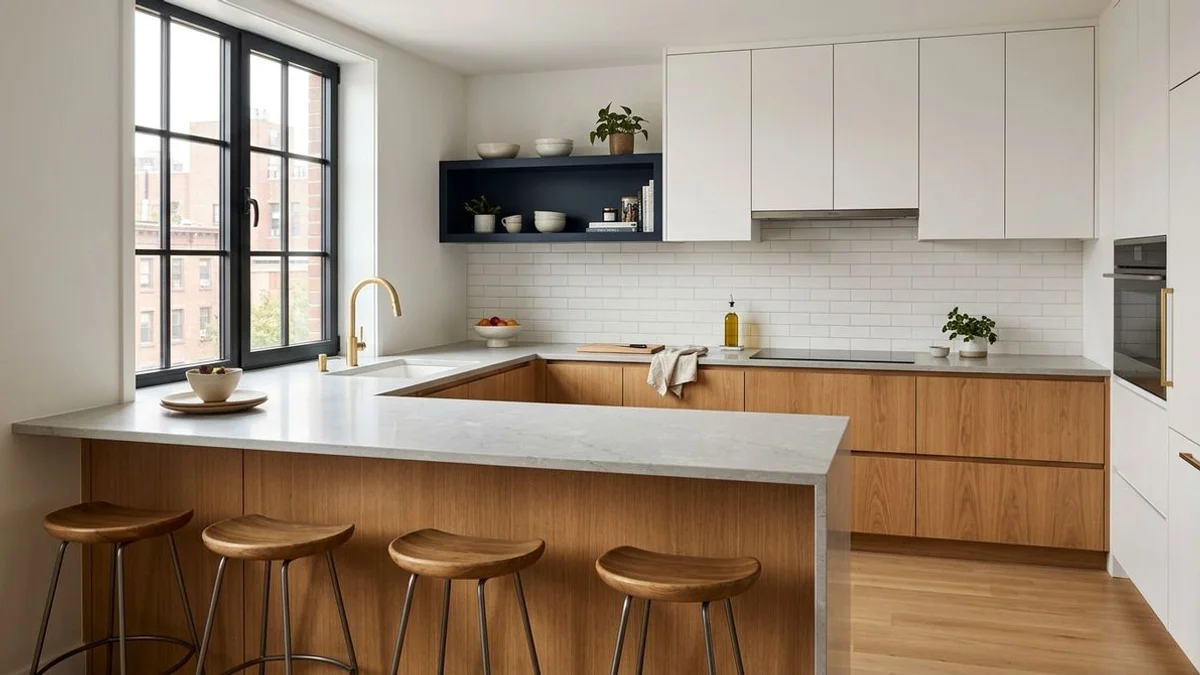
L-shape condo kitchen with peninsula seating