Compact bathrooms are common across Vaughan, from the secondary baths of 1990s and 2000s builder-grade homes to the ensuites in VMC condo units. A sub-50-square-foot washroom can feel cramped, but the right layout and fixtures make a tight space feel substantial. Here is how to make the most of every inch.
Layout for sub-50-sqft bathrooms
The Ontario Building Code dictates strict spacing, so the existing footprint is your primary constraint. You need at least 15 inches of clearance from the toilet centreline to any side wall, and 21 inches of clear floor space in front of the bowl.
Three viable small bathroom layouts:
1. Linear three-fixture (5x8 feet, ~40 sqft). Toilet at one end, vanity in the middle, walk-in shower or tub at the far end. The most common layout when the long wall has the door at one end.
2. Three-fixture L-shape (5x6 feet, ~30 sqft). Toilet beside the door, vanity opposite, shower in the corner. Fits narrow spaces well.
3. Powder room (4x5 feet, ~20 sqft). Toilet and small vanity, no shower. Common as a main-floor second bathroom.
Walk-in shower vs. tub
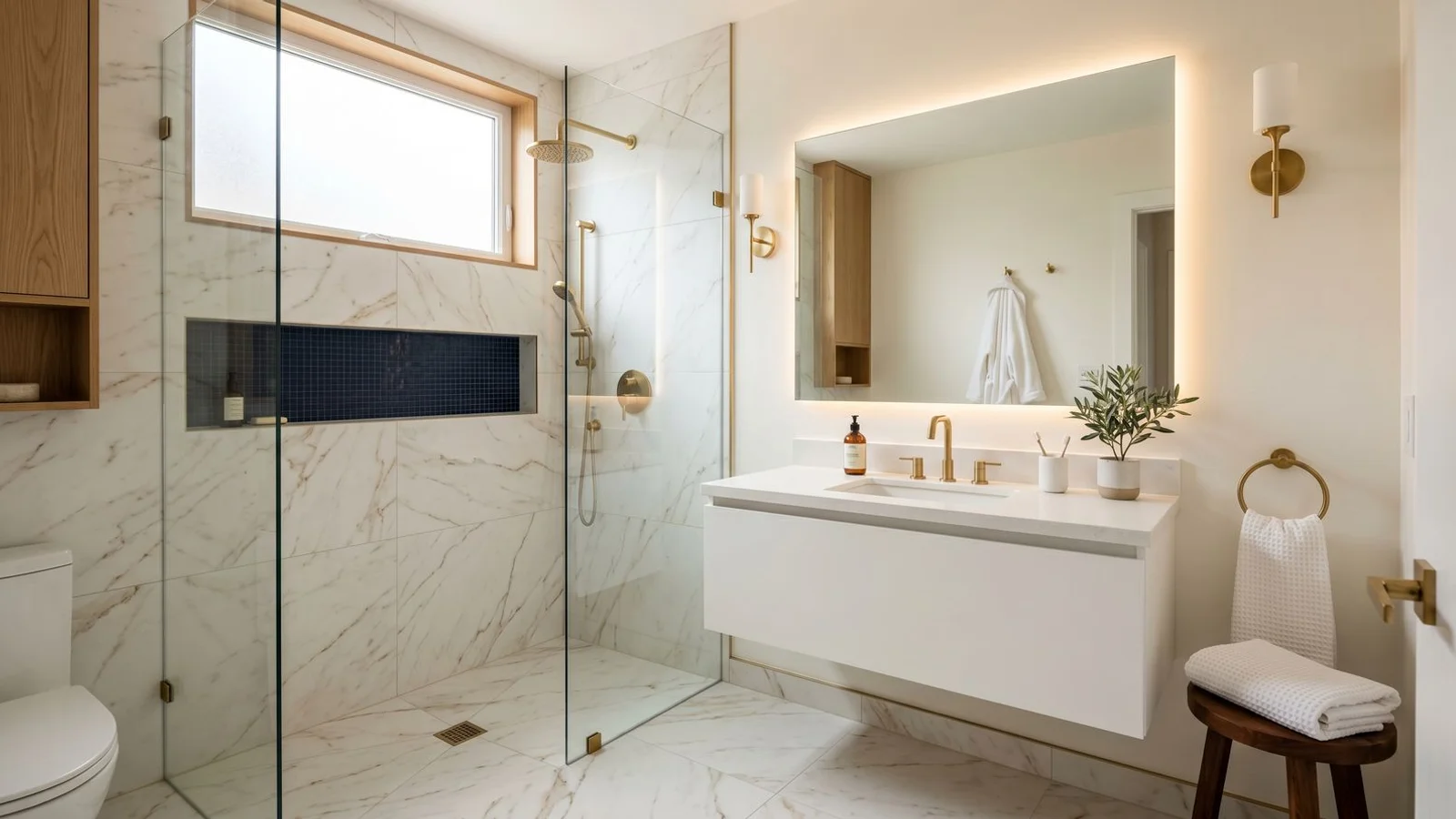
Converting a 30x60-inch alcove tub into a walk-in shower is the best call for most compact spaces, and a curbless design makes the room feel larger. Keep a tub-shower combo if it is the only bathroom in a family home. A walk-in shower wins for a second bathroom, a condo unit, or an aging-in-place primary suite.
Walk-in shower advantages:
- More usable space, with no footprint lost to a bulky basin.
- Curbless designs feel far larger.
- Easier daily access, a major benefit for aging-in-place planning.
- More design flexibility with niches, frameless glass, and linear drains.
Bathtubs still hold value:
- Resale in family homes typically requires at least one bathtub.
- Daily-bath households prefer a dedicated soaking space.
Space-saving fixtures
Wall-hung toilets
A wall-hung toilet maximises floor area. The tank hides inside the wall using a carrier system like the Geberit Duofix, pulling the bowl 6 to 8 inches closer to the wall. Expect to pay $400 to $800 more than a standard toilet.
| Fixture Type | Space Saved | Cost Implication |
|---|---|---|
| Wall-hung toilet | 6-8 inches of depth | Adds $400-$800 |
| Floating vanity | Exposes floor space | Varies by finish |
| Narrow-depth vanity | 5 inches of depth | Cost-neutral |
Floating and narrow vanities
Floating vanities are a major 2026 trend, especially in 24-inch or 30-inch widths. With no legs touching the floor, they visually open the space underneath. Warm wood finishes like oak and walnut are replacing cold grey tones. A narrow 16-inch depth vanity fits linear bathrooms where a standard 21-inch cabinet would block the walkway.
Vertical storage
Build into the walls rather than outward. A standard interior wall uses 2x4 framing, providing about 3.5 inches of hidden depth.
- Recessed niches: built into the shower framing, they hold shampoo while taking zero usable space.
- Tall narrow cabinets: a 12-inch wide full-height cabinet beside the vanity holds towels.
- Wall-mounted shelving: shelves above the toilet use the dead space over the tank.
- Mirror-front medicine cabinets: a 3-to-4-inch deep cabinet adds hidden storage.
Lighting tricks
Single-source overhead lighting flattens a small bathroom. Layer overhead, vanity, and accent fixtures, using LED bulbs at 3000K to 4000K.
- Vanity lighting at face height: sconces beside the mirror eliminate shadows.
- Recessed LED in the shower: brightening the shower helps the back of the room read as larger.
- Toe-kick LED strips: lights under floating vanities add a hovering look and night-time wayfinding.
- Dimmer switches: bright light for cleaning, a softer glow in the evening.
Tile choices that expand perceived space
- Large-format floor tile: 12x24 or 24x48 inch porcelain has fewer grout lines, which reads as a larger floor.
- Continuous floor-to-wall tile: the same tile up the shower wall creates an unbroken sightline.
- Light tile finishes: white and light grey reflect more light than dark options.
- Vertical tile patterns: vertical subway tile draws the eye up and emphasises ceiling height.
- Linear shower drains: a Schluter Kerdi-Line drain allows a single tile plane from the floor through the shower.
What to avoid in small bathrooms
- Ignoring condo rules: Vaughan condo boards require approvals that take 2 to 6 weeks and a contractor with $2M liability insurance.
- Heavy tile choices: dark floor-to-ceiling tile reads as cramped.
- Heavy framed mirrors: a frameless or recessed mirror feels lighter.
- Crown moulding at the ceiling: it visually lowers a small bathroom’s ceiling.
- Bulky vanities with full-length sides: floating or open-leg vanities expose more floor.
- Sliding glass tub doors: the track and frame divide the space visually.
Budget for small bathroom renovations
In 2026, an average mid-range small bathroom renovation lands between $13,000 and $25,000. City of Vaughan permit fees for plumbing or structural changes typically cost $200 to $500.
- Cosmetic refresh: updating fixtures, tile, and paint while keeping the layout: $8,000 to $11,000.
- Mid-range: new walk-in shower, vanity, tile, and fixtures: $13,000 to $25,000.
- Premium: heated floors, premium tile, frameless glass, integrated lighting: $25,000 to $40,000.
Most of our small bathroom projects land in the $18,000 to $28,000 range. Kitchen Renovations Vaughan applies these ideas so your project adds value without wasting an inch. Browse our bathroom renovation service, see the bathroom renovation timeline, or book a free in-home consultation.
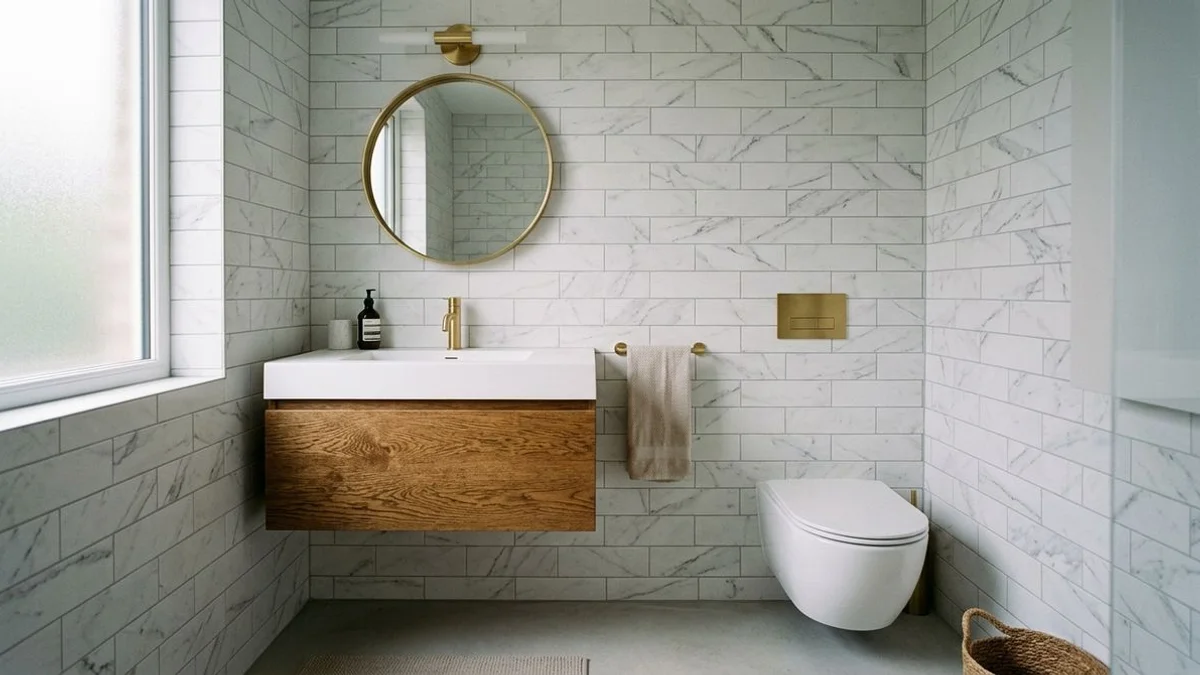
Wall-hung toilet and floating vanity in a small bathroom